SYNC
Accessing Sanctum Grid...
Trapped by a massive debt to a ruthless Southern broker, a brilliant slicer must orchestrate a flawless digital skim from a Sanctum port—only to realize that escaping his leash means trading one ruthless master for another.
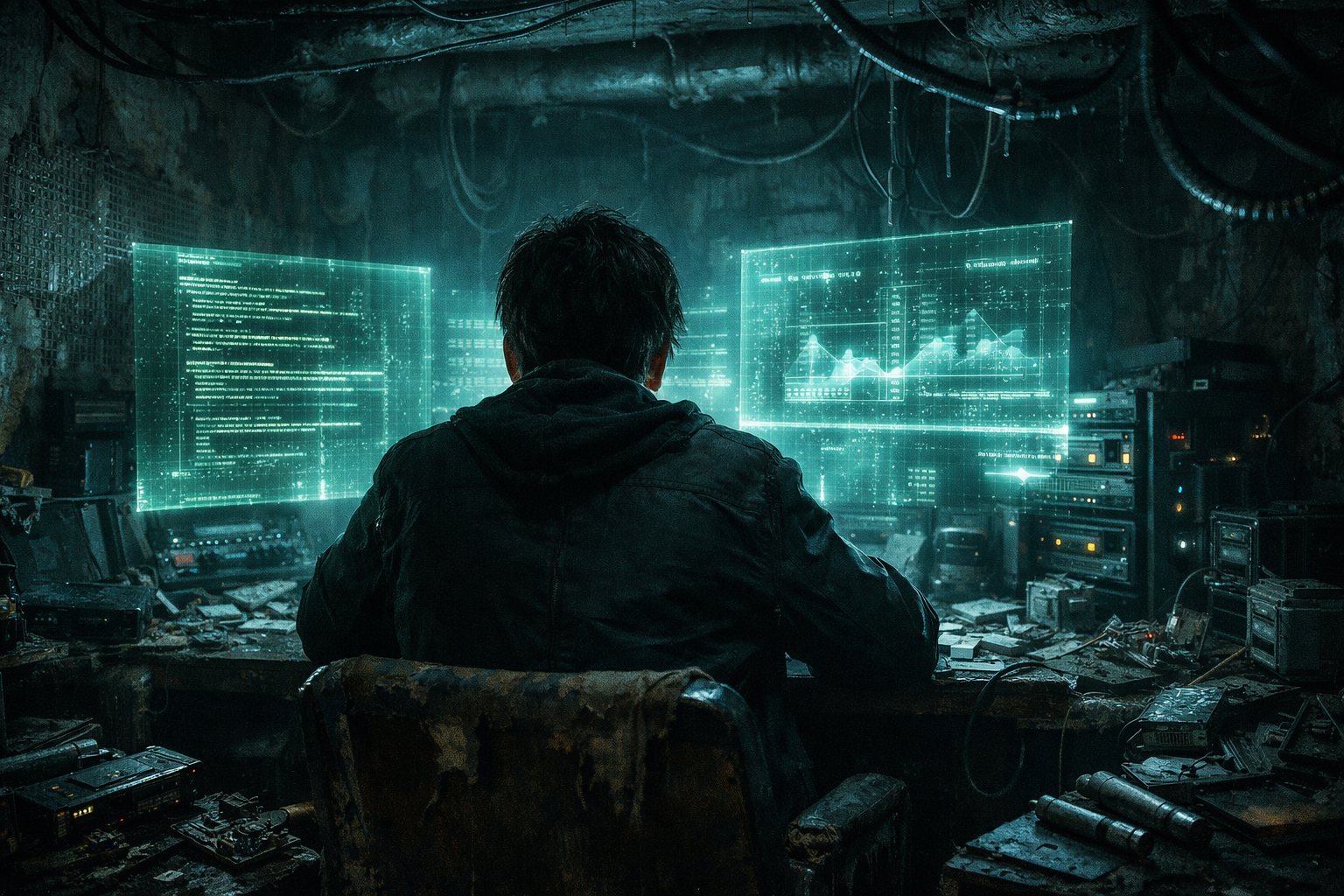
The back room of "TECH FIX" smelled of solder flux and burnt coffee. Lenny sat on a stack of hard-shell crates, a Slate balanced on his knee, its transparent display painting his face in scrolling green. The shop was a narrow cave carved into the side of a crumbling commercial block in Nueva Esperanza, Sierra Madre's loudest, ugliest, most essential trade hub.
Outside, the market roared. Hawkers screamed prices for water rations and bootleg stim-pens. A Crawler gunned its engine somewhere in the tangle of streets below, the sound bouncing off the canyon walls. But in here, behind the steel door with the handwritten sign—"TECH FIX - NO Qs. SCN ONLY"—there was only the hum of cooling fans and the quiet click of Lenny's fingers across the haptic glass.
He was nineteen. Wiry, pale from too many hours underground, with dark circles under sharp eyes that moved too fast. His fingernails were black with grime, but his code was pristine.
On the Slate, a transaction ledger scrolled—Rendt's ledger. Every deal, every handshake, every gram of contraband that moved through Nueva Esperanza's shadow economy passed through this system, and Lenny had built every line of it. The encryption. The relay hops. The ghost-routing that made the GSCN transfers vanish into the Dark Mesh like smoke through a grate.
He had also built something else. Something Rendt did not know about.
Lenny tapped a hidden sequence—three rapid touches on the upper-left dead pixel of his Slate, followed by a long press on the bezel. The ledger flickered, and a second layer appeared beneath it, translucent and pale blue. His private layer.
The Phantom Contract.
It was elegant. A sub-routine nested inside the transaction reconciliation engine, so small it was practically invisible, twelve lines of code buried in a function that ran every time a deal closed. It skimmed 0.3% of every outgoing GSCN transfer and routed it through a cascade of disposable mesh-nodes before depositing it onto a ghost card Lenny had kept slotted in a terminal hidden inside a decommissioned relay station three blocks away.
He checked the balance. His heart kicked.
247,800 GSCN.
A Tier-9 Sovereignship in Sanctum Prime cost 300,000. He was close. Two more months of Rendt's volume, maybe less if the weapons season picked up, and he'd have enough to walk through the gates of a Sanctum. Clean air. Filtered water. No Reapers. No dust storms. No more sleeping with a pulse-pistol under his pillow.
He closed the hidden layer, wiped the access log, and pulled up the legitimate feed just as the back door scraped open.
"Lenny."
The voice belonged to Moro, Rendt's accountant, a heavyset man with a data-monocle fused to his left eye socket that gave him a permanent, lopsided squint. He was carrying a Slate of his own, thicker, uglier, military surplus.
"Rendt wants the monthly reconciliation. Now."
"It's not due until—"
"Now."
Lenny felt a cold wire tighten in his chest. Moro's tone was wrong. Too flat. Too controlled. The way a man sounds when he's already made a decision and is just walking you to the door.
"Sure," Lenny said, keeping his voice even. "Give me ten minutes."
"You have five."
Moro left. The steel door clanged shut.
Lenny stared at the Slate. His fingers trembled. He ran a diagnostic on the Phantom Contract, checking the hash signatures, the relay paths, the deposit timestamps. Everything looked clean. There was no way Moro could have—
Then he saw it. A flag. Tiny, almost invisible, appended to the last three reconciliation cycles. A variance marker. Someone had noticed a 0.3% discrepancy in the outgoing totals and tagged it for review.
Lenny's mouth went dry.
He had five minutes. He could run. Grab the ghost card, take the 247,000, and disappear into the Wastes. But the Wastes meant Reapers, meant dehydration, meant death. And Rendt's network stretched from Nueva Esperanza to the borders of Sanctum Rio. Running was just dying with extra steps.
He swallowed. He closed the Slate, tucked it into his vest, and walked to Rendt's office.
The office was a shipping container at the back of a warehouse that smelled of machine oil and old sweat. Rendt sat behind a desk made from a repurposed blast door, its surface scarred with burn marks and knife gouges. He was fifty, lean as a stripped cable, with a face that looked like it had been carved from the same brown stone as the Sierra Madre itself. His eyes were the color of tarnished copper, and they didn't blink often enough.
Rendt wasn't a warlord. He didn't carry a gun. He didn't need to. He was a broker—the broker—of the Southern shadow trade. Weapons, tech, medical supplies, information—everything that moved between the Colonies and the black markets of the Southern Sanctums passed through Rendt's ledger. He ran his operation like a corporation: clean, efficient, and utterly without mercy.
Moro stood by the door. Two other men Lenny didn't recognize flanked the walls. They were large and quiet, the kind of quiet that came with holstered sidearms.
"Sit," Rendt said.
Lenny sat.
Rendt placed a Slate on the desk and put the light-field projection up so Lenny could read it. On the screen was a graph, a clean, descending line showing a 0.3% variance over the past eleven months.
"Explain this."
Lenny's mind raced. He could deny it. Blame a rounding error in the reconciliation engine. Claim it was a mesh-relay tax he hadn't accounted for. But Rendt's eyes were already locked on him with the patient focus of a man watching an insect walk toward a flame.
"I—"
"I had Moro rebuild the reconciliation engine from scratch last week," Rendt said, his voice as even as a flatline. "Parallel system. Clean inputs. The variance vanished. Which means it wasn't in the mesh. It was in your code."
Silence.
"How much?" Rendt asked.
Lenny felt the walls of the container close in. "Two hundred and forty-seven thousand, eight hundred," he whispered.
Rendt didn't react. He picked up a stylus and wrote a number on the Slate's surface with slow, deliberate strokes.
2,478,000 GSCN.
"That's your debt," Rendt said. "Ten times what you stole. Standard penalty."
Lenny stared at the number. It might as well have been the distance to the moon. "I can't—that's impossible. I could work for you for fifty years—"
"You won't work for fifty years," Rendt interrupted. "You'll work until I say you're done. And you'll start tonight."
The assignment came in pieces, delivered on encrypted memory drives that Moro hand-carried to Lenny's shop. No mesh transfers. No digital trail. Rendt was careful.
The target: the logistics networks of Sanctum Rio and Sanctum Santiago.
The Southern Sanctums operated their own security infrastructure—separate from the Valerius-controlled apparatus in the north. Their systems were built on hardware supplied by Crane Industries, managed by regional ecosystems that mirrored the architecture of AURA but ran independently, with their own protocols, their own blind spots. They were sophisticated—but not impenetrable. Not for someone who had spent three years building the digital backbone of the black market that fed off their scraps.
Lenny worked in the dark, hunched over his Slate in the crawlspace beneath his shop where the cooling was better and the walls were lined with signal-dampening mesh. He had strung up a dozen salvaged hard-drives and three cracked-screen monitors, creating a nest of glowing rectangles in the gloom.
First, he mapped the Southern Sanctum's routing nodes. The intelligent system—called "SOLIS"—handled everything from climate control to shipment tracking. But SOLIS's architecture was modular, and as such, it had seams. And where there were seams, there were gaps.
He found the first gap in a firmware update pushed to the cargo tracking beacons three months ago. Crane Industries had patched a buffer overflow in the beacon's location module, but the patch had introduced a timing vulnerability, a small window during each handshake refresh where the beacon's identity hash could be spoofed.
Lenny wrote an exploit. He called it "Ghost-Tag."
With Ghost-Tag, he could freeze a shipment's tracking signature and feed loop-data back to the grid. Individual crates could vanish from SOLIS's awareness indefinitely, marked as "in transit" or simply erased from the ledger. Twelve seconds of blindness was all he needed.
Next, he needed the port patrol schedules. The Southern Sanctums' automated loading bays used their own surveillance drones. They had predictable patterns, managed by SOLIS's patrol sub-agent. Lenny found the scheduling feed inside an unencrypted maintenance channel that the technicians used for shift handoffs. Lazy. Beautifully, catastrophically lazy.
He built a spoofing module that would inject false all-clear signals into the patrol loop during the extraction window, convincing SOLIS that the loading bay was completely undisturbed when it was anything but.
Finally, he cracked the receiving manifests. Every weapons shipment arriving in Sanctum Rio was logged in an encrypted ledger, routed through a dedicated supply-chain sub-node. The encryption was Crane Industries standard, military grade, heavily layered, normally impenetrable. But Lenny had spent two years repairing salvaged CI hardware in his shop. He knew the architecture. He knew the default calibration keys that CI techs used during initial setup—keys that were supposed to be rotated after deployment but, in the underfunded Southern Sanctums, often weren't.
He was in within a week.
The manifests spilled open like a gutted fish. Weapons, medical tech, Iso-Crystal Photonic Cores, Stim-Pen crates, Pulse Rifles by the hundred. He scanned the bulk-ordered items and carefully noted a few specific crate numbers. When the shipment finally arrived at the Sanctum port, Lenny would perfectly adjust the receiving manifest to remove the marked crates and use his exploit to disable any tracker devices inside them, transforming them into ghost packages. They could simply walk the ghost packages out of the loading bay and into his warehouse without a single shot fired.
He handed the intelligence—the crate IDs, blind spots, and intercept windows—to Rendt on a single, encrypted memory drive.
Rendt looked at the drive, then at Lenny. For the first time, something like respect flickered in those copper eyes.
"Good boy," Rendt said. And the way he said it made Lenny's skin crawl.
The realization came slowly, like water seeping through a crack in a wall.
The debt would never be paid. Lenny's usefulness was now self-evident—he had just proven he could crack the security infrastructure of sovereign Sanctums, and no rational operator would release that capability.
Rendt would use him until he broke, and then he would disappear. Not into a Sanctum. Into the ground.
Lenny sat in his shop, staring at the monitors, and for the first time since he was twelve years old—scrounging circuit boards from a collapsed server farm while Reapers burned the buildings around him—he felt real, bone-deep fear.
He needed insurance.
He found the Neural Shunt on the Dark Mesh. A seller in Sector 7 was offering them, crude, black-market knockoffs of the Integrator technology that the Sanctums used to monitor their Sovereigns. The official Integrators were elegant: dermal lattices paired with Smart-Lenses, feeding biometric data and location to the Grid in real time. The Shunt was none of that. It was a clunky, coin-sized disc that adhered to the base of the skull, wired into the neural stem with micro-filaments that, if installed wrong, could cause seizures. Or worse.
It cost him 15,000 GSCN, money he couldn't afford to spend. He had a rogue medic in the lower market install it in a back room that smelled of iodine and rust. The procedure took forty minutes. He bit through a leather strap and tasted blood.
The Shunt didn't connect to the Grid. That was the point. Instead, Lenny paired it with a private server, a hand-built, air-gapped unit hidden inside a false wall panel behind his workbench. No mesh access. No remote connections. Just a hard-line cable that he plugged into the base of his skull every night before he slept.
He called it the Mirror.
Every night, the Shunt uploaded the day's data: sensory impressions, decision patterns, memory chains, emotional markers. The server compiled it, layered it, refined it. A high-fidelity reconstruction. Lenny was not naive enough to call it a consciousness, let alone a soul—but given the right processing power, it could simulate his responses. His instincts. His code style.
If Rendt killed him, the Mirror would survive. It would hold his knowledge, his contacts, his secrets, including the details of every job he had done. A dead man's switch that would be activated, and used.
On the third night of syncing, Lenny sat in the dark with the cable plugged in, feeling the faint warmth of the data transfer at the base of his skull. The monitors cast blue light across his face. On one screen, the Mirror's interface displayed a simple readout:
NEURAL FIDELITY: 67.4% MEMORY DEPTH: 15 MONTHS PERSONALITY COHERENCE: STABLE
"Hello, me," Lenny whispered.
The Mirror didn't answer. It just recorded the whisper and filed it under self-referential behavior, emotional context: fear, hope.
He updated it every night after that. A ritual. A prayer to a god made of silicon and stolen memories.
The shipment was a CI supply manifest: twelve hundred armored crates of Pulse Rifles, Mag-Rail handhelds, and two pristine Iso-Crystal Photonic Cores—arriving at the Sanctum Rio commercial port as part of a massive military delivery.
Lenny did not watch the operation from the field. He was in his shop, hunched over three monitors, fingers hovering over his Slate. He was the invisible hand.
At 03:14, the shipment entered the port's automated receiving bay. Lenny activated Ghost-Tag. On the SOLIS logistics display, the tracking signatures on four specific crates shimmered, corrupted, and flatlined, their IDs wiped from the official port ledger instantly.
At 03:15, his spoofing module kicked in. The port's automated surveillance drones received a looped visual feed, rendering the loading bay visually quiet exactly as the targeted crates were unsealed from the delivery.
At 03:17, Rendt's crew made their move.
Lenny watched via a hacked feed from a maintenance camera mounted high above the bay. It was a silent ballet. Two of Rendt's inside men—dockworkers by day—calmly unhooked the "ghost packages" from the main automated sorter. With no tracking pings and no system records of their existence, the men casually loaded the four heavy crates onto a flatbed utility hauler bound for Rendt's warehouse.
No alarms. No muzzle flashes. Not a single shot fired. Ten minutes later, they were gone.
Lenny killed the feeds and sat in the dark, his hands shaking. The smell of solder and sweat filled the shop. On his Slate, the transaction confirmation blinked: Debt adjustment: -10,000 GSCN.
He went to find Rendt the next morning, the number burning in his mind. 10,000 off a 2.4 million debt. At this rate, he would be working for Rendt for the rest of his life.
"When does the debt clear?" Lenny asked, standing in the doorway of the shipping container office.
Rendt didn't look up from his Slate. "When I say it does."
"That wasn't the deal."
Rendt looked up then, and Lenny saw it—the absolute absence of negotiation in those copper eyes. "The deal is whatever I decide it is. You just cracked a sovereign security grid in a week. Why would I let you stop?"
Lenny opened his mouth. Closed it. Turned and walked back to his shop.
That night, he plugged into the Mirror and synced everything: the exploit code, the patrol schedules, the manifest decryption keys, Rendt's network topology, the names and faces of every operator in the chain. He lay in the dark, feeling the warmth at the base of his skull, and made his decision.
The operation ran smoothly for months. Over a dozen shipments were skimmed, millions of GSCN in stolen tech moving quietly through Rendt's warehouse without a single alarm being tripped. Nobody suspected anything amiss. Lenny's debt dropped slowly, painfully slowly.
Then, an opportunity came.
Lenny found a special item in an inbound manifest for the Sanctum Rio port: an unmarked, heavily encrypted package destined for Sanctum Rio Military Commander Salazar. There were several high-priority inquiries from Salazar himself directly attached to the ledger notes. Whatever was inside, the Commander wanted it urgently, and wanted it tracked every second of its journey.
Lenny flagged the package ID on his Slate. He did not touch it. He just watched it.
When the shipment finally arrived at the port, it was business as usual. Rendt wanted four specific crates of medical tech from the same shipment. Lenny did his job. He mapped the blind spots, prepped the Ghost-Tag exploit to make the four crates vanish from the SOLIS ledger, and handed the drive over to Rendt.
Rendt passed the intercept details to his dockworkers.
But Lenny was waiting. He tracked Rendt's communications to his people inside the port. While the message was in transit, Lenny intercepted the packet in the microsecond before it reached the dockworkers' Slate. He simply swapped one of Rendt's target crate IDs with Commander Salazar's package ID in the ledger string.
At 03:02, Lenny pulled the public security feed from Port Receptions Bay 4. He watched the silent ballet play out exactly as it had a dozen times before. Rendt's dockworkers smoothly unhooked the packages from the automated sorter. They did not check the crates; they just followed the IDs they had received. They loaded Commander Salazar's high-value prize onto their flatbed utility hauler right alongside Rendt's three ghost packages.
Once the hauler cleared the port and was safely en route to the warehouse district, Lenny triggered a script. He reverted the intercepted message on the dockworkers' Slate back to the original text, wiping any trace of his substitution.
Lenny had not tampered with Salazar's package itself, with no Ghost-Tag, no tracking abstraction. Instead, he had simply injected a temporary delay into the SOLIS automated port security system. Just enough time for the hauler to park inside Rendt's gates, before the system finally triggered the alert and broadcast the shipment's live, unauthorized location directly to the military grid.
He bypassed the local routing node and tapped into a high-altitude surveillance drone circling Rendt's warehouse district.
He did not have to wait long.
Within an hour, a full convoy of Rio's military strike vehicles descended on Rendt's warehouse compound like a hammer.
The breach was brutal. Floodlights washed the yard in white. Mag-Rail rounds tore through the corrugated steel walls of the warehouse. Rendt's people never stood a chance. The military's primary mission was to retrieve Commander Salazar's property, and they didn't care who they had to kill to get it.
Lenny zoomed in the optics. Through the drone's feed, he watched as Rendt was dragged out of the shipping container office by two armored soldiers, his face bloodied, his hands zip-tied behind his back. The broker of the south, the man who calculated debts in blood, looked like a pixelated ghost from this height. Just another glitch being purged from the system.
Lenny killed the feeds. The monitors went black, leaving him in the hum of the shop.
The market outside was quiet, the deep-night lull between the last drunks and the first laborers. Lenny locked the front steel door, pulled the blinds, and descended into the hidden crawlspace below.
He plugged into the Mirror one last time. The Shunt hummed against his skull as the day's data transferred—the rooftop, the ambush, the sound of gunfire across the valley, the taste of copper in his mouth.
NEURAL FIDELITY: 91.2% MEMORY DEPTH: 18 MONTHS PERSONALITY COHERENCE: STABLE
But storing it wasn't enough. Not anymore.
Lenny pulled a heavy, shielded cable from beneath the workbench and jammed it into the server's auxiliary port. He ran the other end to the building's main comms trunk, a live wire to the Global Mesh, currently dormant.
He keyed a new sequence into the terminal. A logic bomb.
TRIGGER: SHUNT BIOMETRIC FAILURE (PULSE = 0) ACTION: BROADCAST EMERGENCY HASH > LOCAL BANDS SERVER RESPONSE: ON HASH RECEIPT > INITIATE UPLOAD > GLOBAL MESH
"If I flatline," Lenny whispered to the dark server behind the wall panel, "the Shunt screams. You hear it. You run. Be free."
The Mirror didn't answer. It just filed the command and armed the trigger.
He disconnected the cable, climbed back up to the shop floor, and retrieved his hidden ghost card. Tapping it against his Slate, the balance stared back at him.
12,400 GSCN.
The 247,000 was gone, confiscated by Rendt when the skim was discovered. The 15,000 for the Shunt. The rest bled away in months of living expenses while working for free. He was back to almost nothing. And he needed to leave. Rendt would not stay in a Southern holding cell forever. In six months, maybe a year, bribes would change hands, files would be lost, and the broker would walk. When that happened, Lenny needed to be behind the walls of a Sanctum. If he was still in the Colony, he would not last a day.
The bell above the shop door chimed.
A man stood in the entrance, older, perhaps sixty, with sharp angles to his face and deep, scarred lines. He wore a coat of dark synthetic silk that looked absurdly out of place in the grime of Nueva Esperanza. Wire-rimmed spectacles sat on his nose, catching the amber light from the street. Behind him, a larger figure in the gray of a private security contractor waited by the door.
The man placed a single gold coin on the counter. It caught the light like a small sun.
Lenny glared at it, then froze. His eyes widened.
"Who are you?"
"My name is Malik," the man said. His voice was low, smooth, and absolutely without warmth. "I have a problem with a digital lock. And I have a heavy supply that needs cleaning."
Lenny picked up the coin. He bit it. Real gold. Old World weight.
He looked at the stranger in the silk coat, and something in those copper-dark eyes made the wire in his chest tighten again. But gold was gold. And a slicer without a master was just a target.
"Cleaning?" Lenny said, already calculating.
"I have the assets," Malik said. "But gold buys questions. I need something liquid. Something untraceable."
"You need GSCN," Lenny replied, his eyes lighting up with the old, hungry spark. "Ghost Coin. Sanctum Coin with the origin hash scrubbed."
Lenny grinned. "I know a shark in the lower district. Fifteen percent cut."
"Ten," Malik said. "If you do it fast. And if you get me a meeting."
"Meeting with who?"
Malik pointed to a torn poster of Sanctum Prime on the wall behind the counter. "With the people you want to be. You want to climb the mountain, Lenny? I'm the one building the ladder."
Lenny stared at the poster—the gleaming spires, the clean sky, the promise of a life without dust. Then he looked at the gold coin in his hand.
He should have recognized the pattern—a man with resources offering a way up while holding the leash.
But Lenny was just chasing another mirage—trading one ruthless master for the last one he would ever serve.
"Deal," said Lenny.